







“Accelerating Data Center
Construction”
DPDC, Daiwa House Industry’s Data Center BrandDaiwa House Industry continues its tireless pursuit of speed as it works to build societal infrastructure as quickly as possible.












The two extremes of massive and
compact

We watch videos on our smartphones, make cashless payments, and take part in online meetings. Stores analyze sales trends, trucks’ delivery routes are optimized, and trades in financial markets are updated in milliseconds.
Our lives can no longer function without huge volumes of data. Underpinning this trend are data centers—facilities equipped with many servers that store and process data.
Daiwa House Industry’s data center brand D-Project Data Center (DPDC) offers the two extremes of scale, from some of Japan’s biggest projects to small facilities the size of tennis courts.
DPDC Inzai Park, located in Inzai, Chiba Prefecture, is a project to develop 14 data center buildings on a site of about 270,000m2 or the equivalent of 5.7 Tokyo Domes. A power distribution company agreed to build an ultrahigh voltage substation on a corner of the site. Its 1,000MW capacity is roughly three times the generating capacity of Japan’s premier Kurobe Dam hydroelectric power station.
Our Module DPDC data-center product resides at the other end of the scale. All functions are tightly packed in a building with a floor area of about 200m2—smaller than a tennis court. We built our first Module DPDC in Okuma-machi, Futaba-gun, Fukushima Prefecture, and it doubles as a showroom.
Though our huge-project centers and our compact product are completely different in scale, they share one signature characteristic: a short timeline to deployment.
The first building in DPDC Inzai Park was a project for AirTrunk Japan Operating G.K. (AirTrunk Japan)—AirTrunk’s first location in Japan. AirTrunk operates hyperscale data centers in the Asia-Pacific and Middle East. The company urgently needed to build infrastructure to accommodate demand from customers, global mega-cloud businesses.
AI startup RUTILEA, Inc. became the first Module DPDC building’s tenant. A strong player in the AI industry, RUTILEA is certified by Japan’s Ministry of Economy, Trade and Industry as an AI infrastructure business alongside major corporations. It, too, was in a hurry: GPUs, the brains of AI, evolve on an almost annual cycle and can become outdated if construction takes just a few years. Our ability to get the data center up and running rapidly was a make-or-break condition.
So what did we do to meet this extreme requirement for speed? To find out, we need to look back to the Inzai, Chiba Prefecture, project, the launchpad for Daiwa House Industry’s dive into the data-center business.
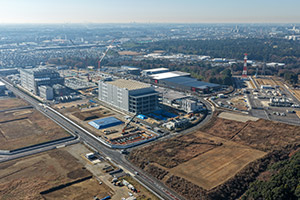
DPDC Inzai Park,
one of Japan’s largest data centers
(December 2025)
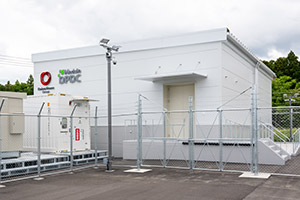
Data-center–product Module DPDC
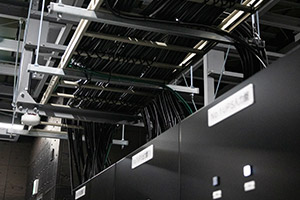
Integrated design,
construction, and kitting out



Exposure to a global company’s
speediness
It all started in 2017, before Daiwa House Industry’s Data Center Business Division even existed. Salesman Kazuma Kitano was assigned to Tokyo Head Branch where he now leads the Data Center Business Division’s sales team.
Although today he is at the forefront of the business, back then he was struggling and frustrated because he could not see a future for himself. “I had a hard time landing contracts when I was in construction sales. I was seconded to a joint venture with a major company for a while, but didn’t have much success there either. I carried that frustration for years.”
When he was assigned to Tokyo, the team he joined had just acquired land in Inzai. Asked by his boss whether he wanted to take on a development role, he agreed, feeling pressure to do whatever he had to to prove himself.
The tract was developed as an industrial park, and Kitano was selling plots and facility construction services. Out of the blue, he heard that AirTrunk wanted to launch a hyperscale data center in Inzai.
AirTrunk did not only want land. Norihiro Matsushita, AirTrunk Country Head, Japan, reflected: “We were looking for a long-term partner with expert knowledge and understanding of Japanese laws and regulations and how to negotiate with the central government who could execute projects reliably.”
Kitano and his team had no knowledge of data centers, but they were confident in Daiwa House Industry’s technical expertise in delivering quality products. But then they were then confronted with the demand for speed far beyond their norm.
For example, AirTrunk communicated formal decisions two hours after a meeting and demanded a reply “by tomorrow.” The whole team grappled with this sense of urgency. They chased the Daiwa House Industry director responsible for final approvals late into the night, begging him to make a decision that day. Learning that the director was scheduled to go overseas on business, they rushed to the airport to meet him before he departed.
The team had to negotiate with AirTrunk’s management team entirely in English. Business discussions and communication were often challenging due to differences in language and business customs.
“We made so many mistakes and were far from perfect. I thought about quitting after being reprimanded by people in our company and elsewhere,” Kitano admitted. But he made no promises he couldn’t keep to ensure that the customer did not end up with unresolved problems. He addressed all challenges in advance and went ahead with the project with caution, but at speed.
AirTrunk’s Norihiro Matsushita expressed his solid trust in the team. “The design and equipment of hyperscale data centers vary between the businesses that use them, and their specs are constantly evolving. For this reason, the difficulty lies in having to complete something that should take a long time very quickly. The Daiwa House team nevertheless honored the deadlines that were top priority for us. We overcame adversity with Mr. Kitano, and continue to do so every day.”
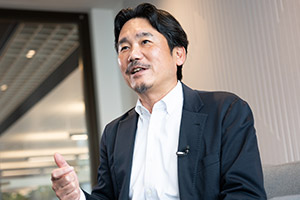
Norihiro Matsushita, AirTrunk Country Head,
Japan
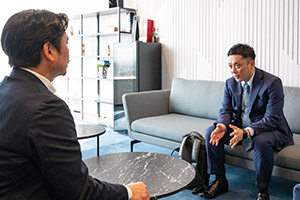
Daiwa House Industry picked up world-class design philosophy and operational know-how



Both developer and general contractor
Daiwa House Industry’s strength lies in its having the competencies of both a developer and a general contractor. That combination enables it to undertake whole projects as an integrated process from land acquisition to infrastructure construction, design, construction, and operation.
Factors that determine the outcome of data center development projects are finding the land and getting access to electric power. Competition is intense for suitable sites with low natural-disaster risk and stable access to plentiful electric power.
Most data centers are in economic and data-demand centers: Tokyo and the Kanto region, and Osaka and the Kansai region. Although the national government is pushing for siting in outlying regions, suitable locations are few.
How, then, is Daiwa House Industry able to secure suitable sites? The answer lies in its nationwide sales network of around 160 offices. They gather land information in real time through relationships with local real estate companies and municipalities. These relationships span decades and provide us access to information before it is public. As a developer, Daiwa House Industry also has the skill to identify land with business potential.
In practice, however, it takes over five years (more like 10) for a developer to build the extra-high voltage infrastructure needed to connect to the grid backbone, a hurdle that stalls many a project. Inzai, in Chiba Prefecture, is no exception in experiencing a sharp increase in demand for electricity. Future power shortages remained a risk if AirTrunk were to locate its data center there.
Kitano and his team jumped into action. They approached TEPCO Power Grid, a Tokyo Electric Power Holdings Group power transmission company, with an invitation to build a substation on the development site. The proposed location was an irregularly shaped section at the site’s far end. Although inconvenient for a commercial facility, it would work for a substation since substations are not too fussy about location.
This prompted TEPCO Power Grid to install the Chiba Inzai Substation—its first new ultrahigh voltage substation in 24 years. It completed a massive project that would normally take 10 years (and included digging a 10 km transmission-line tunnel running from another substation) in an extraordinary four years.
Having secured the land and power, it was now time for Daiwa House Industry’s construction capabilities to shine. Although it has sophisticated construction and facility engineering capabilities, the design flow of data centers is the reverse of that for the usual construction project.
Morikawa, the project equipment engineer, explains: “For other kinds of facility, you design the building structure and install the equipment. Data centers are the other way round—you design the building around the machinery and equipment going inside. Our biggest challenge was to changing our mindset so that the equipment came before the building.” But he relished the challenge. “As the equipment engineer, it was incredibly rewarding to be involved with power infrastructure on such a huge scale.”
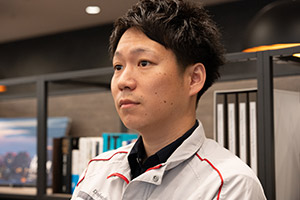
Morikawa volunteered for the project
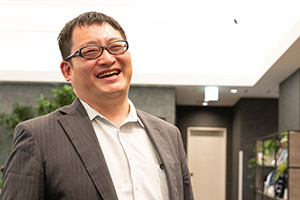
Sales Chief Miyake
matured into a reliable specialist
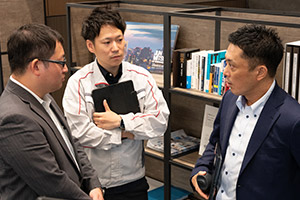
Collaborating specialists’ teamwork a strength



Deploying new societal infrastructure
in the area
The young team members stepping into the unknown world of data centers eagerly absorbed knowledge, by not only reading books and references but also interviewing experts. They then conferred frequently and deeply to come up with the next innovation.
Working to deliver what the world needs, where it is needed, more rapidly than before. This is how the Module DPDC was born, reflecting the spirit of our founder, who said: “speed is as the greatest service of all.”
Daiwa House Industry was able to get the center up and running quickly by turning to lower-capacity high-voltage electricity rather than waiting for the extra high-voltage connection.
The company shortened the time needed for approvals by keeping the floor area to 200 m2. Many components were factory-made on a standardized design, harnessing Daiwa House Industry’s expertise as a business founded on the “industrialization of housing” concept.
As an all-in-one full-package product including all the features of a custom-build—seismic resistance, sound insulation, tight security, and more—Module DPDCs can be delivered roughly within a year of contract conclusion.
Takuto Igawa, Director and COO, RUTILEA, Inc., a tenant of Module DPDC Fukushima, was impressed:
“From a security perspective, we want to have our own data center in-country where we can develop generative AI and deliver it to customers without having to rely on overseas mega-cloud businesses for computational resources for generative AI. Daiwa House Industry’s Module DPDC offers tremendous value to the rapidly evolving generative AI business because additional small installations can be built quickly. All the improvements we thought were needed have been deployed, and we are delighted with the optimized equipment layout in the 200 m2 space and the high ceilings, which make bringing in and updating equipment easy.”
Module DPC will accelerate the decentralization of data centers around the country and demonstrate the true merit of Daiwa House Industry, which has a decadeslong history of community development and community service all over Japan. And combining Module DPDCs with logistics facilities in development projects brings the potential to deploy digital infrastructure as part of local revitalization projects as well.
Kitano and his team are looking ahead, working on a scheme for the evolution of the data-center construction business into a digital infrastructure business. Daiwa House Industry owns the building and rents out the space in a “co-location model,” while the “hosting model” entails collaborating with a partner with specialist expertise like RUTILEA to lease space and equipment as a package. The possibilities are endless.
One day, the DPDC data-center brand will become an essential part of the societal infrastructure like water and electricity, one that underpins all society’s activities.
Ishihara, Deputy Manager, Business Management Department, is warmly supportive of Kitano, who has been working tirelessly to build societal infrastructure. “He experienced the tough world of industries that move goods when he was assigned to a joint venture. On this assignment, he took on another difficult challenge—negotiations. I have big expectations that he will build on this experience, forge a new path that nobody in the company has walked before, and lead the way for younger employees.”
Shouldering these expectations, Kitano is refreshingly humble: “The data-center business started because Daiwa House Industry owned land in Inzai and AirTrunk presented us with an opportunity. This led to a relationship with RUTILEA, and now we’re dipping our toes into the generative AI business. Next, I want to be the person who finds new businesses.”
Exposed to the breakneck speed of global companies and startups, Daiwa House Industry learned the hard lesson that being a huge organization means it takes time to make decisions. But there is no time. We have to be nimbler in seeing the signs, making decisions, and taking action. Every moment, even now, our speed is tested in Japan and worldwide.
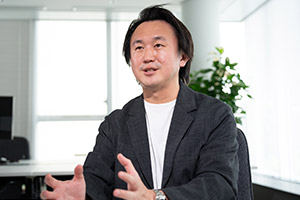
Takuto Igawa, Director and COO, RUTILEA, Inc.
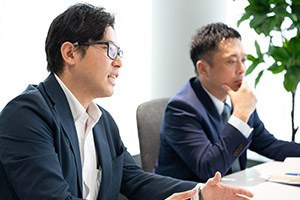
Katayama, a member of the sales team,
proposes the next phase of project
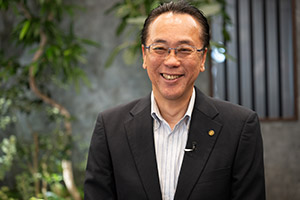
Ishihara, Deputy Manager, Business Management Department of envisions the future of the business and employees
*All information as of July 2026