The Daiwa House Group's nature-positive vision
The construction and real estate industry depends heavily on nature for many of the materials essential to building construction, while development and construction activities have significant impacts on the natural environment. In community development, even though altering nature is inevitable to some extent, the industry can also play a role in restoring nature through its business activities. The Daiwa House Group is therefore committed to making nature-positive practices the norm in society, so that we can build sustainable communities where people continue to live healthy, fulfilling lives in harmony with nature and pass them on to future generations.
The Daiwa House Group's Nature-Positive Actions
“Let’s connect greenery!”
In 2010, the Daiwa House Group became the first Japanese house manufacturer to release a comprehensive Biodiversity Declaration. Ever since, the Group has been taking biodiversity into consideration in early project stages across its business activities. In 2021, we integrated our previous efforts and established a new group-wide green space promotion concept called “Let’s connect greenery!”, and with it, we are taking on the challenge of becoming nature positive.
Urban areas continue to attract more people, causing residential developments to expand, which has led to concerns about the reduction and fragmentation of Japan’s unique natural environments. To address this situation, the Group is working to protect thriving green spaces for the next generation while minimizing its impact on ecosystems. By pursuing urban development in harmony with nature, we are helping to build ecosystem networks while creating high-quality communities.

Building green spaces with native species Creating two million square meters of ecological green space by 2035
A distinctive feature of the Daiwa House Group is its involvement in the creation of a large number of different facilities across Japan. As a community-focused business, we construct, manage, and operate a wide range of facilities, from homes and stores, to factories, offices, and logistics centers. By taking advantage of our position, we are working to create more green spaces, and making them larger and more accessible.
The ecosystems found in Japan vary according to the local geography. Accordingly, the Group has divided its business territory into nine regions based on the National Land Classification for Biodiversity Conservation created by the Ministry of the Environment. For each region, we have created a list of native species that have thrived there for a long time. By planting a variety of trees, including native species, based on the relevant list, and by improving habitats for local organisms, we are helping to create a network of vibrant ecosystems.

Source: National Land Classification Map for Biodiversity Conservation
(Created by Daiwa House Industry based on the draft map from the Ministry of the Environment)

Planting based on the local native vegetation and cultural heritage
(THE MIRAI KACHI KYOSO Center, Nara Prefecture)
Since ecosystems vary depending on the geographical region of Japan, planting native species in line with the regional classification ensures the sustainability of ecosystem networks.
Scientific evidence Forecasting the biodiversity recovery effect of native species landscaping
In cooperation with Think Nature Inc., we assessed the future impact of the Daiwa House Group's native species landscaping initiatives and evaluated their contribution toward ensuring no net loss.
In a collaborative project with Think Nature Co., Ltd., we estimated that the cumulative green space loss associated with our business activities amounts to approximately 2,000 hectares. This result was based on an estimated reduction of approximately 80,000 hectares of green space caused by urbanization between 1977 and 2022 and a related decline in biodiversity of more than 50%. The assessment confirmed that by continuing to work toward achieving greening using 50% or more native species on properties, it is possible to achieve a net gain* before 2050, more than offsetting the biodiversity loss attributable to our business activities over our entire history.
* Net gain: Improving the natural environment and biodiversity to a condition better than that which existed prior to development.
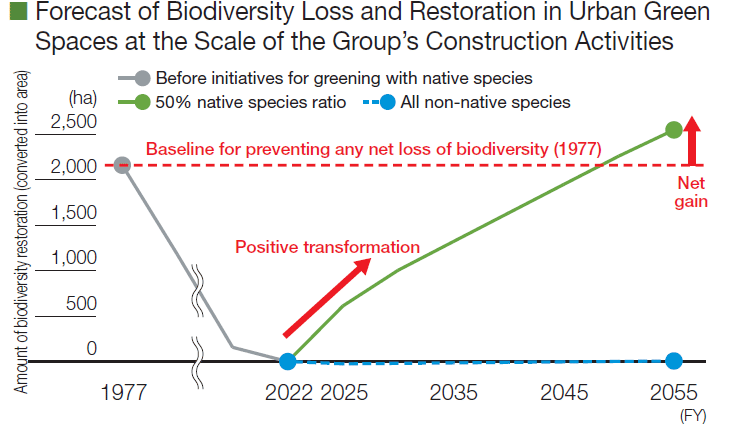
We aim to restore more biodiversity than was lost due to our business activities over our entire history, thereby achieving a net gain by 2050
Toward Urban Nature Positive Daiwa House Group Initiatives for Urban Ecosystem Restoration
By practicing biodiversity-conscious design and community development across all regions, we aim to create more than 3 million m2 of ecosystem-conscious greened area by 2035 (cumulative total from fiscal 2022 onward). For large-scale developments such as condominium projects and logistics facilities, we are also actively pursuing certification from the Association for Business Innovation in Harmony with Nature and Community (ABINC), to demonstrate the high quality and scale of our green space creation and biodiversity conservation efforts. By valuing local natural environments and creating rich green spaces within communities, we strive to develop places that will be cherished landscapes for generations to come.


PREMIST Shonan Tsujido condominium project (Kanagawa Prefecture) *Sold

Mie Asahi Logistics Center built for Japan Transcity Corporation (Mie Prefecture)
Our commitment to 30by30 Conserving biodiversity in collaboration with stakeholders
The Daiwa House Group works together with a wide range of stakeholders, including citizen groups, academic experts, and local communities, to conserve biodiversity at its facilities. The 30by30 initiative seeks to help build a nature-positive world by promoting the target of conserving at least 30% of land and sea areas as natural environments by 2030. Looking to help meet this target, we continuously implement ecosystem monitoring, conservation activities, and environmental education programs. At sites where conservation activities are undertaken, we actively pursue certification as Nationally Certified Sustainably Managed Natural Sites under a system established by Japan’s Ministry of the Environment, and we promote community development that contributes to biodiversity conservation. Based on our Corporate Creed of “Fostering employees’ personal growth through business,” we also provide opportunities for diverse stakeholders to connect with nature. Across these activities, we seek to develop people who can work together to protect and cultivate natural assets, while also promoting the social transformation needed to build a world that lives in harmony with nature by 2050.


Taisei Pond, Royal City Daisen Resort (Tottori Prefecture)

BRANCH Kobe Gakuen Toshi (Hyogo Prefecture)
* Recognized as a Nationally Certified Sustainably Managed Natural Site
Solutions based on nature A multifaceted approach that takes advantage of the Group’s comprehensive strengths
We are actively working to create Nature-based Solutions (NbS), a type of action proposed by the Kunming-Montreal Global Biodiversity Framework. By adopting advanced technologies such as green infrastructure, we are helping not only to conserve biodiversity but also to address climate change and enhance society’s resilience.
Group companies also help to create natural assets in urban areas by, for instance, managing urban parks, including Osaka Castle Park, and carrying out rooftop and wall greening projects. These activities help enhance people's physical and mental well-being while strengthening social ties within communities.
The Daiwa House Group also promotes initiatives that help preserve traditional cultures and landscapes with deep ties to the local natural environment. By creating green spaces that reflect region-specific vegetation and cultural characteristics, we contribute not only to biodiversity conservation but also to the preservation of each area's unique identity and heritage.

Chiba Park (Chiba Prefecture)

Grand Ring Greening Project (Osaka Prefecture) *Dismantled
Participation in the Global Nature Positive Summit 2026
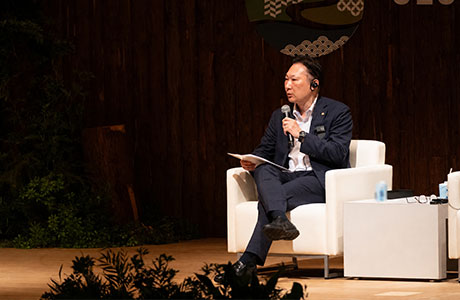
At the Global Nature Positive Summit 2026, held in Kumamoto City in July 2026, Daiwa House Industry participated in a session on “Nature-Positive Infrastructure in Terrestrial and Marine Areas.” During the session, we introduced our native species greening initiatives based on our Group-wide greening concept, “Let's connect greenery.” We also showcased how we use nature technology to quantitatively assess contributions to biodiversity. By presenting our progress, we shared our approach to facilitating community development that promotes harmonious coexistence with nature.
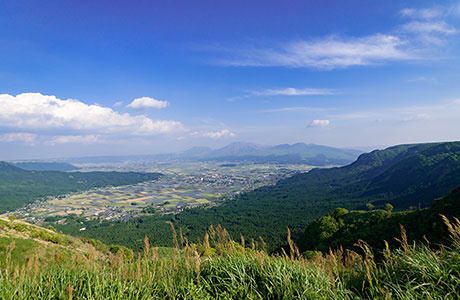
Restoring Aso's Native Grasslands: A Path Toward Biodiversity Conservation (Japanese text only)