Social issues Japan’s policies to achieve carbon neutrality
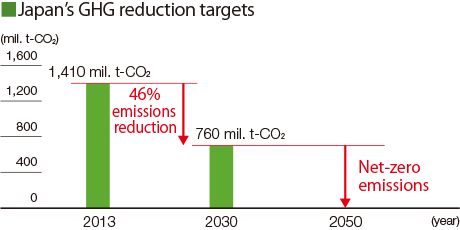
GHG emissions reduction
Reducing greenhouse gases emissions by 60% by 2035 (vs. FY2013)
The Paris Agreement, adopted at the UN Climate Change Conference (COP21) in 2015, sets the goal of achieving net-zero greenhouse gases (GHG) emissions. In response, the Japanese government declared its commitment to achieving carbon neutrality by 2050 in October 2020.
Between January and February 2025, the Japanese government released the 7th Strategic Energy Plan, the GX2040 Vision, and the revised Plan for Global Warming Countermeasures. These policies were formulated to achieve a stable energy supply, economic growth, and decarbonization simultaneously.
The revised Plan for Global Warming Countermeasures, published in February 2025, presents a roadmap toward carbon neutrality and sets ambitious targets to reduce greenhouse gases emissions by 46% by 2030, 60% by 2035, and 73% by 2040, all compared with fiscal 2013 levels. * Source: 7th Strategic Energy Plan, GX2040 Vision, and revised Plan for Global Warming Countermeasures
Renewable energy expansion
Boosting the share of renewable energy in the national energy mix by 2030
Achieving carbon neutrality is regarded not only as a means of improving Japan's energy self-sufficiency and securing a stable energy supply, but also as an important initiative for driving technological innovation and economic growth.
The 7th Strategic Energy Plan, GX2040 Vision, and the revised Plan for Global Warming Countermeasures identify securing sufficient decarbonized power sources as a critical issue that will determine Japan’s industrial competitiveness and economic growth, particularly as electricity demand is expected to increase with the advancement of digital transformation (DX) and green transformation (GX).
Accordingly, these policies emphasize the importance of ensuring a stable electricity supply by maximizing the deployment of renewable energy while combining a diverse range of decarbonized power sources.
* Source: 7th Strategic Energy Plan, GX2040 Vision, and revised Plan for Global Warming Countermeasures
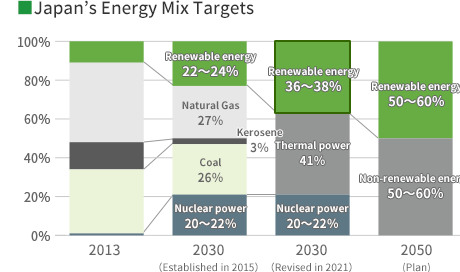
*Created by Daiwa House Industry using information from the website of Japan’s Agency for Natural Resources and Energy
Industry challenges and response measures Emphasizing energy efficiency and energy generation
GHG emissions reduction | Challenges
Household and business sectors account for approximately 30% of total emissions
The household and business sectors together account for approximately 30% of Japan's greenhouse gases emissions. Reducing emissions in these sectors is therefore essential to achieving carbon neutrality by 2050.
The Daiwa House Group's businesses are primarily associated with these sectors. In particular, reducing energy consumption during the use phase of buildings is key to reducing emissions.
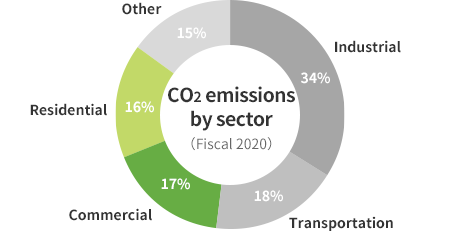
*Created by Daiwa House Industry using information from the website of Japan’s Ministry of the Environment
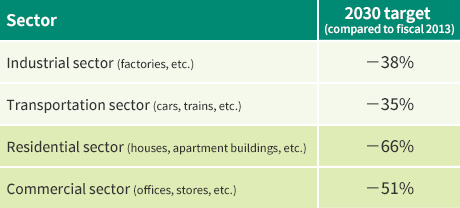
*Created by Daiwa House Industry based on the Plan for Global Warming Countermeasures (Cabinet approved, October 22, 2021)
GHG emissions reduction | Response measures
Reducing greenhouse gases emissions in the occupancy and use phase
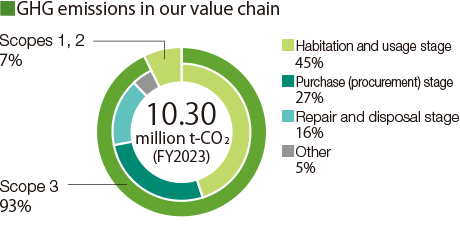
A distinguishing characteristic of houses and buildings is their length of use. The average lifespan of a Japanese home is about 30 years, and most of the GHG emissions occur in the occupancy and use phase of its life cycle. For the Daiwa House Group, emissions generated in the occupancy and use phase of the buildings it produces account for approximately 45% of the GHG emissions of its entire value chain. Therefore, in order to reduce total emissions, the Group needs to construct buildings that require as little energy as possible when in use. Two keys to this are ensuring high insulation performance and installing energy-saving equipment.
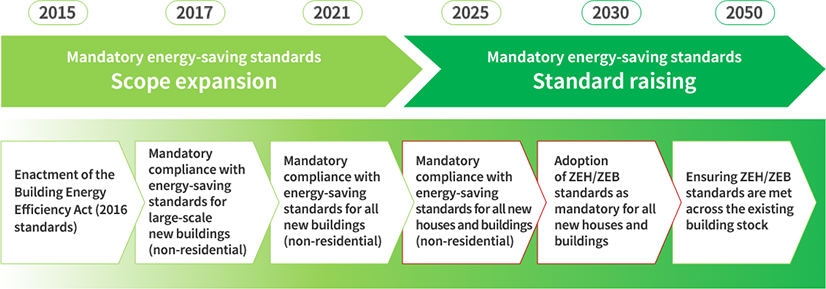
Legislation to improve the energy-saving performance of buildings
Since the Building Energy Efficiency Act was enacted in 2015, compliance with national energy-saving standards has been progressively enforced according to the purpose and size of buildings. In April 2025, compliance was made mandatory for all new buildings (residential and non-residential). The goal is to gradually increase the standards so that by 2030, all new buildings will achieve ZEH and ZEB levels of energy-saving performance.
Renewable energy expansion | Challenges
Lack of suitable sites for solar facility construction
Since Japan’s adoption of a feed-in tariff system (FIT) in July 2012, the development and operation of large-scale solar power facilities (solar farms) has progressed rapidly. As a result, the level of renewable energy in Japan’s power source mix rose from 10% to 23% between fiscal 2011 and 2024, and renewable energy adoption has expanded. However, because of its small land area and mountainous terrain, Japan’s levels of solar power generation compared to total land area and usable flat land are already the highest among major developed nations. Suitable sites for solar farm construction that also ensure nature conservation and natural scenery preservation are becoming limited.
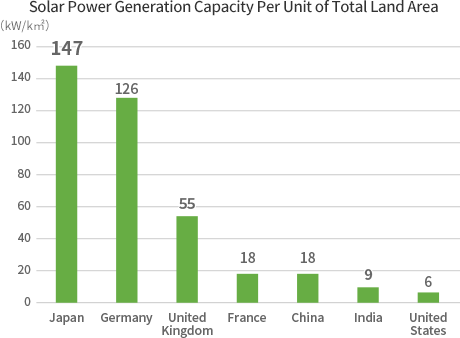
*Created by Daiwa House Industry using information from the website of Japan’s Agency for Natural Resources and Energy
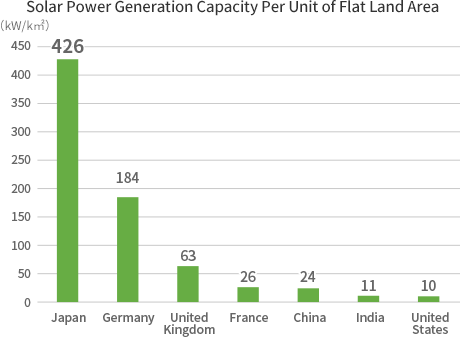
*Created by Daiwa House Industry using information from the website of Japan’s Agency for Natural Resources and Energy
In the relatively small country of Japan, there is a shortage of suitable flat land for solar farm development while still ensuring conservation of nature and rural scenery.
Renewable energy expansion | Response measures
New options for securing installation sites
To ensure the continued adoption of renewable energy, Japan needs to develop its unused land, while ensuring that facilities can coexist with local communities. Due consideration must also be given to equipment safety as well as environmental and scenery preservation, while exploring possibilities for using uneven terrain. Moreover, the roofs of existing houses and buildings are effective choices for new solar installation. The Plan for Global Warming Countermeasures also clearly states that the use of these options should be maximized.
Business strategy Vision of the Daiwa House Group
In light of these social trends, the Daiwa House Group has revised the milestone year of its long-term environmental vision from 2030 to 2035 and formulated the Endless Green Program 2029, an environmental action plan covering fiscal 2026 through 2029. To achieve carbon neutrality, we aim to bring greenhouse gases emissions across the entire value chain to zero by taking thorough energy-efficiency measures and using renewable energy. In addition, by taking adaptation measures to avoid or minimize the negative impacts of climate change, we aim to conduct business activities that are resilient to climate change risks and help build a safe, secure society.